Kevin Wilcox has spent his life at the edge of the map, quite literally. He grew up on Grand Manan Island, located in the Bay of Fundy between New Brunswick and Maine. There, his curiosity was shaped by the ocean. Eventually, so was his career.
Today, Kevin is an Assistant Professor in Geodesy and Geomatics Engineering at the University of New Brunswick and a researcher with the Ocean Mapping Group. In both capacities, Kevin helps to reveal the parts of our planet we still know the least about. His work takes him from the rugged Canadian coast to the icy expanse of Antarctica, where precise positioning isn’t just helpful — it’s essential.
In this customer spotlight, Kevin shares with us what drives his passion for ocean mapping, how he blends adventure with analysis, and why the Arrow Gold+ GNSS receiver with Galileo High Accuracy Service (HAS) became a key part of his recent Antarctic bathymetry expedition.
1. Why are you passionate about your job?

The ocean has always been part of my life. I grew up on Grand Manan, a small island in the Bay of Fundy, so being on and around the water shaped me from an early age. The ocean is also one of the last frontiers; each of us depends on it every day, but there is still so much we don’t know. I enjoy the balance my work gives me in being able to have both hands-on field operations and analysis and modeling at my desk. It is a great mix for any technically minded person who values putting theory into practice.
2. How did you first find out about Eos Positioning Systems’ GNSS products?
I first learned about Eos through a colleague at UNB who had known Eos’s leadership team through previous industry activities. My team and I at Ocean Mapping Group were looking for a practical way to achieve high-accuracy GNSS positioning in Antarctica. There, there are no RTK networks and establishing a land base station wasn’t feasible due to our operational constraints. The Arrow Gold+® with Galileo High Accuracy Service (HAS) corrections was an ideal solution for our problem.
3. What do you use Eos GNSS products for?
The Arrow Gold+® is integrated into our uncrewed surface vehicle (USV) to provide HAS-corrected positioning. This is used alongside our inertial measurement unit (IMU) to calculate the position and orientation of the multibeam sonar at a high frequency (e.g., 100 Hz). This high-precision, high-frequency positioning is then used to geolocate seafloor soundings, which are converted into bathymetry.


4. Do you have a favorite experience or memory from your projects with Eos hardware?
One of the most memorable moments for me was one of our first days mapping in Admiralty Bay, which is in King George Island, South Shetland Islands, Antarctica. The weather was perfect: beautiful, clear skies and flat, calm mirror-like water. All around were walls of ice hundreds of meters tall; it was truly breathtaking and one of those actual once-in-a-lifetime moments. To be out that day, driving the USV back and forth collecting bathymetric data was a highlight for sure.


5. Do you have a favorite feature of Eos GNSS receivers?
I feel like in a lot of the Eos customer spotlights I’ve read, people like to talk about the ease of connection and Bluetooth® with the GNSS receivers. I’m going to go in a completely different direction. For my work, integrating the Arrow Gold+® directly into the data acquisition workflow over physical connections was key. This included sending live, high-frequency data to the acquisition software as well as writing of raw receiver data in binary format for post processing. With the additional serial output port on the receiver, I could have two separate wired connections, each configured separately with the Eos Utility software to specify exactly what messages I wanted output (e.g., what connections, at what rates). This is probably a less common case, but if you need it, you need it, and the Arrow Gold+® allowed me to do exactly that.

6. Is there anything we didn’t ask you that you’d like to share with us?
Throughout my time working with the Arrow Gold+®, the Eos team has been truly fantastic. Quick, detailed, and personable responses to any questions, very happy to help in any way they can, and I would happily recommend them to anyone.
Explore Related Content

The First All-Canadian Antarctic Expedition Uses Galileo HAS and Eos GNSS to Map Underwater Features
Discover how the first all-Canadian Antarctic research expedition achieved high-accuracy underwater mapping using the Arrow Gold+ and Galileo HAS — all in one of the world’s most remote, RTK-free environments.
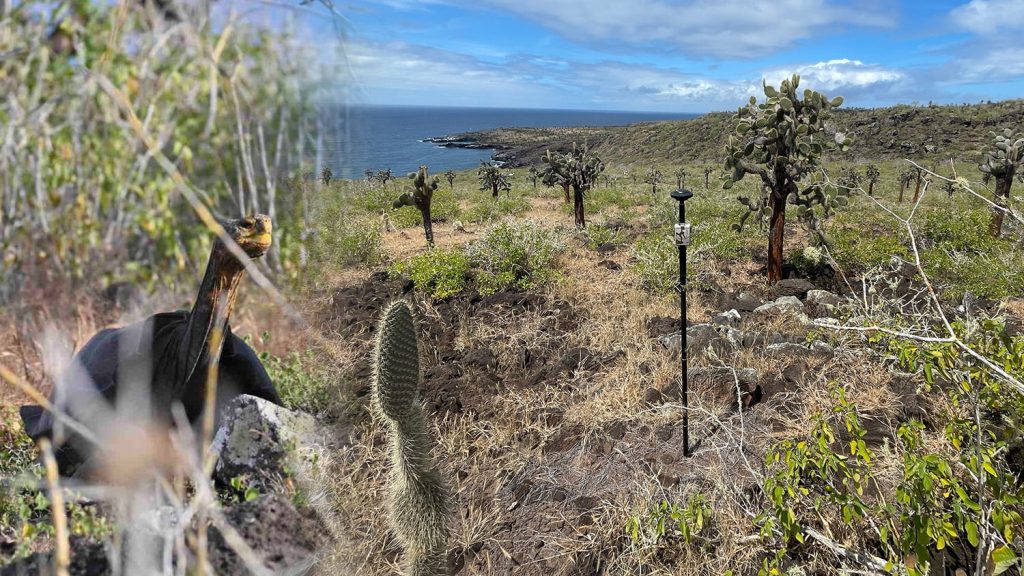
Do Giant Tortoises Make Good Neighbors?
Charles Lehnen uses brand-new Galileo HAS corrections with the Arrow Gold+ in the Galápagos archipelago. His work will study Santa Fe Island’s rewilding.