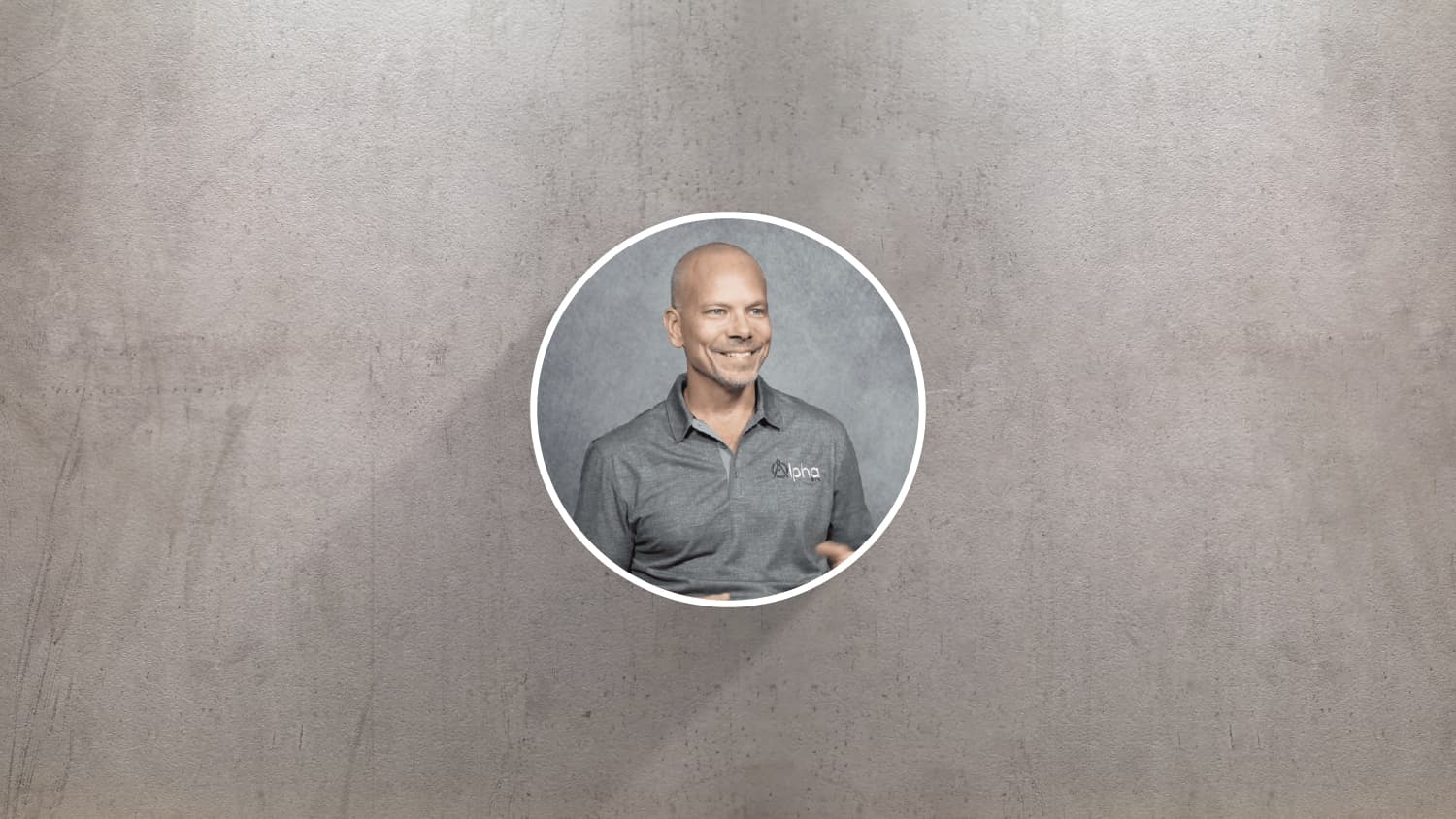
As Eos Positioning Systems (Eos) celebrates its 12th anniversary, we’re taking a moment to celebrate someone few companies get to know: our very first user.
Twelve years ago, while working at a different organization, current AlphaRTK Founder Chris Kahn was introduced to Eos as it was being created. After spending long hours with our soon‑to‑be founder, discussing the company vision, and witnessing the early performance of our prototype receivers, Kahn eventually became the world’s first user of Eos GNSS technology.
But early adoption doesn’t guarantee long‑term loyalty. In a recent interview, Kahn shared exactly why Eos GNSS receivers have become the only devices he trusts for the GIS services he offers around the world. Watch the seven-minute video below, or scroll through the transcript …
Transcript
CHRIS KAHN, FOUNDER, ALPHARTK: So I’m really proud of the fact that I believe I was Eos [Positioning Systems’s] first customer. I met the founder before that and really had long days with him, so I got to know the character of [his] work ethic and problem solving. When I heard that Eos was being formed, I was excited and first in line. I haven’t looked back since.
Chris has become a recognized expert in deploying geospatial technology
At the time, there were other devices that I would use in the repertoire. Those are all since long gone — at least eight or nine years gone at this point. I don’t make any recommendations for any other devices. If a client wants to use another device, I don’t work with the client.
AlphaRTK delivers many high-accuracy GIS projects across the Caribbean
So I do a lot of work in the in the Caribbean. The first client I had down there was Barbuda Ocean Club. It’s a project from a company called Discovery Land Management, which has about 40-50 super-high-end residential private golf-club communities around the world.


They tend to be and really exotic places, sometimes run-of-the-mill places, but they always take on the historical culture of the area. And so they build the architect towards that, which is really … it’s really something to be on one of these properties.


They ran into a problem in the Caribbean where they needed to be offline, because this particular project was a desert island. [It was] very lightly populated, [had] no infrastructure really to speak of, and they had to build everything from scratch.
There was only Internet available at the base camp, which was seven miles away from the project. And that Internet was satellite and slow.
So they needed to be offline. They need to be sub-inch, [meaning] they needed to [have] offline mapping with sub-inch accuracy. And they need it to be fast.

So at the time [I] was [using] ArcGIS Collector in offline mode paired with an Eos Arrow Gold®. And then fast-forward to today, I’ve got clients now moving into the new Skadi [GNSS receivers].
But that project was remarkable because it saved them tens of thousands of dollars a day.
So they were doing earthworks on golf-course construction stakeouts, and they were dragging around slow, heavy, expensive survey equipment on tens of thousands of points that they needed to take. I was able to introduce the Eos technology and have laborers be doing survey accuracy — not survey work — but survey-accuracy work on things like earthworks and stakeouts, which did not need the surveyor there. They just needed that accuracy and that speed.

And so they were taking, you know, a couple thousand points a day versus a handful a day. And the accuracy …. It’s funny on this project, you know, we have 3D scanners and all sorts of really high-end equipment from the surveying side. [Now,] we can go and do things with the Eos equipment and get laughed at by the surveyors — until we compare notes, and it’s exactly the same. So it’s pretty neat to see that kind of thing.

What does a typical AlphaRTK project look like?
Typically [we work] on undeveloped land that is becoming a very, very high-end private resort. They are building all the utilities from nothing. They’re bringing in all telecommunications from nothing.
And so it’s a harsh environment. Higher accuracy is needed. Speed is needed. And reliability is needed, which is why I always use Eos in those projects.


AlphaRTK is adopting new Eos Skadi GNSS receivers for more efficient field work
So [Skadi] Tilt Compensation™ and the [Skadi] Smart Handle™. One of my clients, and they’re very new [to GIS and GNSS in that department], is Rutgers University.
I work with the Biological Sciences team at Rutgers University. We produce a trying to a ton of multi-spectral drone analyses, and we do a lot of GPS work. They were previously using Arrow [GNSS receivers]. They just recently acquired three Skadis. And they’re really excited about the Skadi [smart handle] offset, the laser in there, because one of the farms is a, is a cranberry bog. There’s lots of ditches and mud and muck that they don’t want to walk through. So to be able to just hold it up and shoot that offset really quickly, you know, saves someone from having to put on the waders. So that that that’s one immediate benefit on that.

Tilt compensation is great to be able to just get onto those building corners and outside the overhangs. The ironic thing about tilt compensation with Eos — and this is not a criticism, this is a compliment — is that Eos [receivers are] so good at maintaining connectivity, that if you put it next to a building, it often doesn’t even lose its satellite. So it can be flushed up against the wall of a building. And nine times out of 10, it’s fine, it maintains RTK. But if you really want to make sure that you’re getting that below a centimeter, just, you know, just tilt[ing] it out a little bit, gain a couple more satellites and drop[ping] that root mean square down a little bit (depending on what your requirements are) can be really helpful.

So, you know, those two features [with the Skadi Smart Handle and Skadi Tilt Compensation] were a long time coming. I was very excited about them from the first whispers I heard about them a couple years ago. So I’m really excited to see those finally come to fruition.
The result of working with Eos for over 10 years? Productivity
I’ve been working with Eos in different capacities for over 10 years now. If I could sum it up in one word, it’s been productivity. So I, I’ve been working 25 years in the geospatial space. I worked with plenty of devices before Eos was around. And that’s really night and day. It’s all been all about productivity. When we can go from dozens of points a day to thousands a day, that worker productivity is — is amazing.
And you know, as for running my own company: To be able to have the client be self-sufficient and not have to rely on an outside consultant to do the work for them [is great]. I’m a small business. I run in. I train them how to do this. I say, “You can do this. Here’s how easy it is.” I train them on Skadi in a day or less, and then they’re off to the races. So for me, it really makes my life a whole lot easier.

Special thanks
Eos would like to extend a special thanks to Chris Kahn and AlphaRTK for sitting down for this interview; to Esri for providing the space and opportunity; and to Rogue Monkey Media for filming this interview.
Explore Related Content

Where Are They Now? Kinetik
Texas pipeline company Kinetik is expanding its use of high-accuracy mapping with the Arrow Gold® to 2,400 newly acquired miles of pipeline in New Mexico, after success in Texas.

Do LaB’s Festival Planning Hits All the Right Notes with Eos GNSS
Do LaB streamlined construction and layout accuracy for the Lightning in a Bottle festival by using Eos GNSS receivers and ArcGIS.