Manny Lopez’s work begins where history, landscape, and community meet. As the GIS Manager for ASM Affiliates’ Hawai’i offices, Manny helps his team meet client needs in archaeology, historic preservation, and regulatory compliance. The firm’s mission centers on cultural resource management, but what drives Manny — and many of his colleagues — is something deeper: the responsibility to document, protect, and honor Hawaiʻi’s cultural heritage.
For Manny, maps are more than a way to get somewhere. They unlock stories of the past. His daily geospatial work helps archaeologists, community members, and clients understand land in context. In Hawaiʻi, where culture is not only preserved but still actively lived, that connection carries real weight.
In this customer spotlight, Manny shares what fuels his commitment to documenting the past in GIS, why a handwritten sticky note led him to Eos Positioning Systems, and how the Arrow 100® and Skadi 100™ GNSS receivers have become essential partners in his field work.
1. Why are you passionate about your job?
There’s real satisfaction in knowing that what I do directly contributes to something meaningful. A large part of my role involves turning data into visual stories — whether through cartography or drone‑derived digital twins — that help people understand and connect with the landscape.
That connection is especially powerful in Hawaiʻi, where culture is not just history, but also something actively lived and practiced. Being part of the documentation process deepens my appreciation for both the past and the future. I get to actively support the recording, preservation, and long‑term management of historic places. My role is to apply geospatial tools, while I work alongside passionate archaeologists and community members applying their own expertise. It’s a group effort with meaningful results, and as part of this team, I get to partake in the stewardship of the land. That combination of technology, place, and purpose is what drives me.

This 3D model shows one of the features from the same project: a modified depression. A modified depression is a naturally occurring dip or depression in the ground surface, which humans intentionally modify to serve a particular purpose. As the model suggests, it looks like rocks were moved to the perimeter while leaving the internal area relatively clear. “In this case, given that this modified depression is in an agricultural setting, it’s possible that it was used for planting or even as an intermittent habitation site,” Manny says. Data for the 3D model was captured using drone‑based photogrammetry for digital preservation.
2. How did you first find out about Eos Positioning Systems’ GNSS products?
The introduction was surprisingly low‑tech. Back in 2019, our former GIS Specialist, Ted Bibby, left a sticky note on my desk that simply read: “Check out Eos receivers.” He was already exploring new options for our team that included more robust GNSS and GIS workflows.
I followed up by reaching out to our Eos representative, who quickly shipped two Arrow 100 units to our office. Once we put them into the field, the impact on our workflow was immediate — and we’ve been using Eos products ever since.
3. What do you use Eos GNSS products for?
Eos GNSS receivers are foundational to our documentation process. Our field work spans everything from large, multi‑day reconnaissance surveys to daily monitoring and Unmanned Aircraft System (UAS) ground control point collection. We pair them with Esri’s ArcGIS® Field Maps mobile application and custom data dictionaries to capture anything we might come across. In many cases we are documenting ancestral archaeological features for the first time in modern history.


Once our field work is complete, I begin the data-analysis part of our workflow. I take our spatial data and begin to form a picture of how it fits in with other features, geo-rectified historical maps, and the current environmental landscape (e.g., soils, geology, elevation). Our team of archaeologists can then use this spatial picture begin to answer the five W’s (i.e., who, what, where, when, why) and provide data-supported guidance to clients and the community.
4. Do you have a favorite experience or memory from your projects with Eos hardware?
My favorite memory was using the Arrow 100’s for the first time in the field. At the time, we were using not only a new type of receiver but also iPad® tablets and ArcGIS Field Maps (which was still ArcGIS Collector back then). I was only a couple of months into my current position, our project area was over an hour away, and I was suggesting a new piece of equipment for the office — it was a real make-or-break moment in my career. But the Arrow units did their thing, the staff was impressed, and I walked away excited for all the new possibilities.
Another favorite was running the 2025 Esri User Conference (UC) 5K in San Diego, California, with a Skadi 100™ in hand. I had emailed our Eos representative to suggest the idea, and he was more than happy to facilitate an on-site receiver for the race. The entire Eos team was supportive and excited for the venture. It’s a wonderful memory of blending work, technology, networking, and running (my other passion).


5. Do you have a favorite feature of Eos GNSS receivers?
Several features stand out. Out‑of‑the‑box SBAS corrections have been a game changer — submeter accuracy without post‑processing saves a tremendous amount of time. Pairing the Eos GNSS receivers via Bluetooth® to ArcGIS Field Maps is seamless, and setup is refreshingly simple — no elaborate configurations required.
The grab‑and‑go nature of the Skadi units is another major advantage. Getting staff into the field quickly matters, and Eos makes that happen. The receivers are also impressively rugged. On the Big Island, conditions can shift from blazing sun to heavy rain in minutes. Whether we are surveying dry, dusty Kona terrain or wet, overgrown sites on the Hilo side — wherever our crews go, the Skadis keep up.
6. Is there anything we didn’t ask you that you’d like to share with us?
I would just like to acknowledge all of ASM Affiliates’ archaeologists and field crews on both the islands and the mainland. They all deserve the spotlight as well. I can confidently say they all share the same passion and connection to the cultural landscapes we get to explore. Pairing the right tools like Eos with the right people is an excellent combination in cultural resource management.


Explore Related Content

The First All-Canadian Antarctic Expedition Uses Galileo HAS and Eos GNSS to Map Underwater Features
Discover how the first all-Canadian Antarctic research expedition achieved high-accuracy underwater mapping using the Arrow Gold+ and Galileo HAS — all in one of the world’s most remote, RTK-free environments.
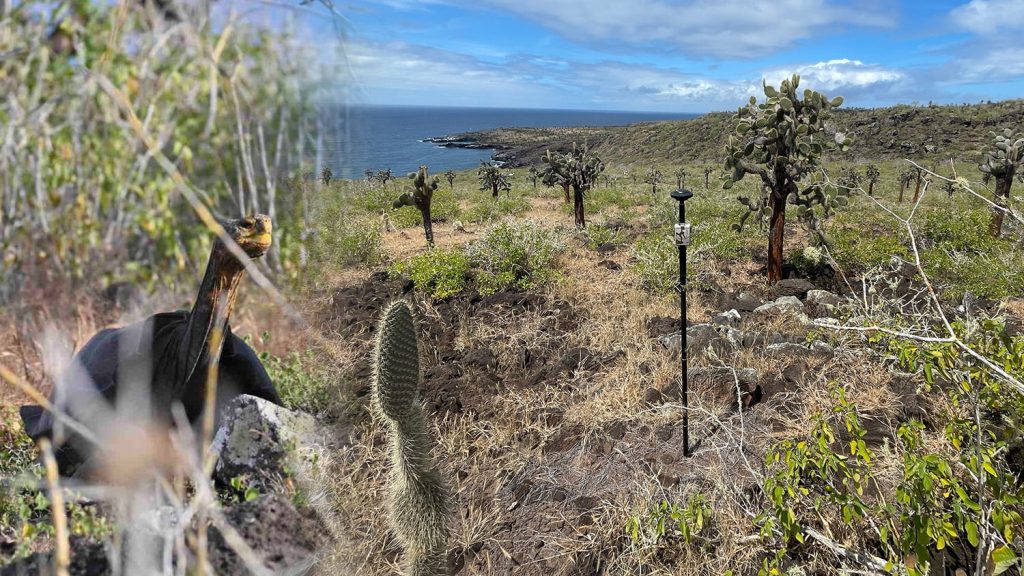
Do Giant Tortoises Make Good Neighbors?
Charles Lehnen uses brand-new Galileo HAS corrections with the Arrow Gold+ in the Galápagos archipelago. His work will study Santa Fe Island’s rewilding.