Overview
Public Rights of Way (PRoW) underpin access, safety and maintenance planning, and [they] are a remarkably extensive national asset for the UK. But many local authorities still rely on fragmented records and sporadic surveys.
Sheffield City Council’s PRoW network spans everything from dense urban streets to Peak District terrain. With legacy data, manual processes and limited resources, the team needed a modern, accurate baseline they could trust for funding, maintenance regimes and liability management.
Gavin Brooksbank, senior engineer with Sheffield City Council’s PRoW Team, gives us the lay of the land. “Our work can go from legal work records to ancient path claims. Then on the other side of that is maintenance and footpath enforcement and project work.”
“I used to work in Highways,” Gavin tells us. “And when I came into the Public Rights of Way team, it became quite apparent that our records, our mapping, weren’t really up to scratch and up to date.”
The Challenge
“I used to work in Highways, and when I came into the Public Rights of Way team, it became quite apparent that our records, our mapping, weren’t really up to scratch and up to date.”
— Gavin Brooksbank, Senior Engineer, Sheffield City Council
Across the UK, stories like Sheffield County Council’s are common; decades-old paper maps, inconsistent digital files, and ad-hoc, legacy surveys leaving teams struggling to prove what they know on the ground.
Without an accurate and unified record of assets, it’s difficult to manage liability, prioritise maintenance or make evidence-based funding bids.
“For us to be able to access other areas of funding, we need data; there’s funding available for certain things if we can put together a good case for it. My initial thinking was that we really need to get a handle on what we’ve got in terms of assets and liabilities,” Gavin explains.
“One of the other things that also became quite apparent, from going about various jobs on the network, is that we’ve probably got quite a lot of definitive footpath not recorded correctly. Our network that isn’t available to the public, usually through obstructions or changes in land use, not recorded either. We really wanted to be able to record and do something about all these different elements.”
With data integrity as a technical goal, Gavin and his team knew that tackling the challenge of their asset records could increase visibility, accountability and funding. A disjointed asset view means slower, less-informed decisions and higher liability risk. But reliable spatial data tells the whole story: what exists, what’s missing, and what needs attention. For councils, it’s the difference between reactive maintenance and strategic asset management.
“I believe the last time we’d had any kind of asset survey done was over fifteen years ago,” Gavin recalls. “And that was all done manually. I think it was before we were really using any kind of GIS software. We have a data set with all those paths on, but we didn’t really have any data that showed what our assets and liabilities were on those routes, and if those routes were still available to the public.”
Many authorities could tell a similar story: years passing between surveys, layers of change unrecorded, and critical information undigitised. Every year without an updated asset record was increasing both operational risk and maintenance backlog for Sheffield City Council’s PRoW team.
“Public Rights of Way are set in law,” Gavin continues. “Every footpath, bridleway and byway sits on the definitive map, the legal record we hold. But things change. Diversion orders, closures and creations build up, so you end up with the map and a big stack of legal orders saying what moved. Ideally, you consolidate it all every five to ten years. But we just don’t have time for that.”
The Solution
The PRoW team began exploring how to modernise without overstretching their in-house GIS resources. “We only have a very small team who look after spatial data for the whole of the Council,” Gavin explains. “I went to the higher ups and talked about software we already had and could use that wouldn’t cost us anything, and we settled on Esri’s [ArcGIS] QuickCapture.”
Though QuickCapture was a good fit for their needs in terms of software, Gavin and his team trialled using it with hardware they already had at hand; a phone or a tablet, and ran into issues. “Pretty quickly we realised that wasn’t going to work. It wasn’t going to be accurate enough. There were a lot of issues with the quality of the data we were getting. So that’s how we came to wanting to purchase Skadis.”
For a team stretched across urban and rural terrain, Eos Positioning Systems’ Skadi 100 GNSS receivers offered the accuracy and flexibility the team needed. While MGISS often recommends ArcGIS Field Maps for deeper workflows, QuickCapture paired with Skadi 100 receivers gave the Council an ideal balance: simple, field-ready usability with sub-metre accuracy.
Skadi devices are designed to work with any software environment, providing a seamless bridge between the field and GIS. Ease of use means that field teams can focus on surveying, not on managing complicated hardware.
Sheffield’s first step was a data cleansing exercise, aligning digital records with legal orders and the definitive map, which would be essential to establishing data integrity. Once validated, field teams began capturing line data, recording the surface of every footpath, and point data for key assets like bridges, stiles and gates.
“A really important thing that the people upstairs wanted us to get a handle on was our structures,” Gavin explains. “We have quite a lot of bridges on the network, for example, but not knowing where they all are leaves us in a tricky situation for maintenance regimes and legal liability.”
The plan for Gavin and his team was to have a base level of data to then focus in on smaller aspects of that data and go more granular. “For example, with bridges,” he tells us. “When we’ve got all the base data, we’ll then know how many bridges we’ve got and where they all are. Then it may be a case of going out and resurveying just the bridges, to record the type, the construction material.”
This base layer of accurate data is now supporting planned follow-up surveys, where individual asset types will be revisited for detailed condition assessment, material classification and maintenance scheduling.


The Results
“It’s been a couple of months since we received the Skadi receivers and it’s going really well. The fact that you can use it with any software and there’s not much you need to do to use it, that was the real thing that attracted me. It’s really flexible and really simple. So I can give the units to the people I’ve been training and say, ‘OK, off you go!’”
— Gavin Brooksbank, Senior Engineer, Sheffield City Council
In a world where time and resources are always limited, Sheffield’s team could immediately start capturing reliable data without major training or disruption.
“We’re getting through the scheme of work, getting through probably a year’s worth of work, covering the whole network with that basic data layer of assets.”
Gavin explains that with the Skadi 100 receivers feeding directly into Sheffield’s GIS environment, the Council now has a real-time, trackable view of its network. “It’s exciting for me, coming from a background of dealing with data,” he tells us. “I open my projects, and I can see where everyone’s been and all the assets that are getting put in—it’s filling up with data. It’s quite exciting!”
This means Sheffield City Council can now communicate clearly with decision-makers, justify budget requests and plan maintenance with confidence. “Now I can go into meetings with the budget holders and politicians and say, ‘I’ve got 10,000 kilometres of gravel track that could do with resurfacing, and I know that because I’ve surveyed it, I’ve got the data.’”
“The big thing with local authorities now,” Gavin continues, “Is we don’t just get a big pot of money at the beginning of the year to do with how you see fit. You’ve got to have the data to go and ask for what you need. That was a huge frustration before. We need that data to be able to say, ‘There’s the facts.’”
“We did try and start doing some surveying without the Skadi,” Gavin added. “I got a couple of cheap receivers, but that was slow going, and the data was off. I was spending a lot of time correcting after going out and recording the data and then bringing it back to the office to find that it was way off; that’s not where I was stood, that’s not where that track goes. Then having to fix that all manually in the office.”
“So we’ve got four Skadi 100 units now and we’ve got people out and about and data is coming in most days, and the quality and accuracy is spot on for what we need. And from the MGISS side, the onboarding was good, communication when it came to delivery delays was great, no complaints at all.”

“The difference it’s made for us has been twofold. I spend less time having to double-check data and manipulate it because it’s coming in incorrect, as I did before. And the ease of use has meant that we can get all the staff members who don’t even necessarily work in this field out using devices because they don’t need any big training sessions. It’s been ideal.”
— Gavin Brooksbank, Senior Engineer, Sheffield City Council
You May Also Like One of These Posts
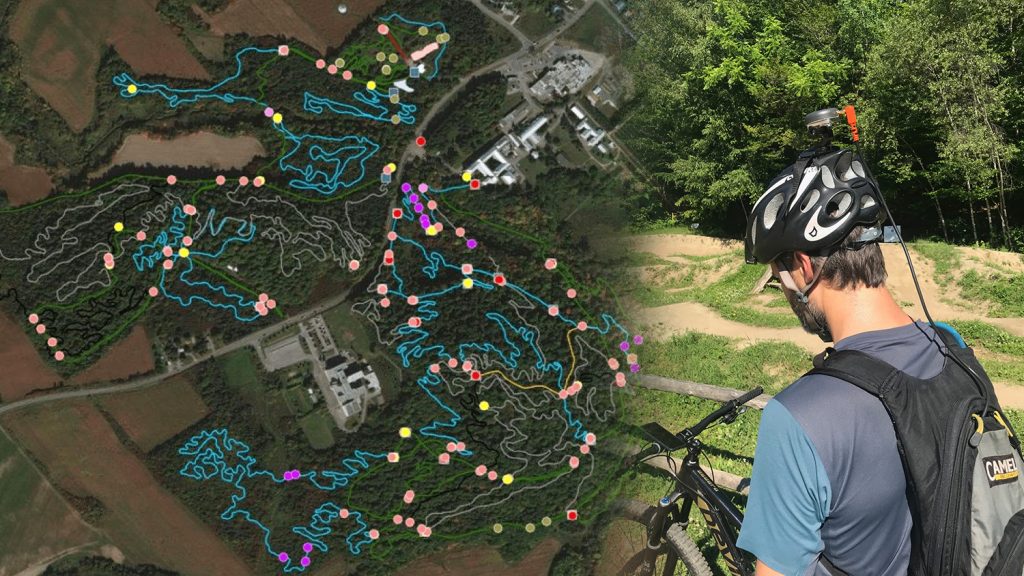
Field Data Collection Improves Access to Québec Mtn Bike Trails
Velo Quebec uses Arrow 100® and ArcGIS QuickCapture to quickly map bike trails at speed. The data helps ensure land owners maintain the trails.

Each Precious Drop: California Utility Maps Recycled Water System with High-Accuracy GNSS and GIS
California’s sixth largest public water utility, EMWD, manages its recycled water system with high-accuracy locations from Skadi Gold, Skadi Tilt Compensation, and Arrow Gold GNSS receivers.