Delaney Hanson’s path into geographic information systems (GIS) has been shaped as much by coursework as by fieldwork. As a graduate student at the University of Southern California (USC)’s Spatial Sciences Institute (SSI), Delaney has gained hands-on experience using global navigation satellite system (GNSS) receivers, drones, and other geospatial tools through immersive fieldwork.
While mapping invasive fennel on Catalina Island with an Arrow 100® GNSS receiver from Eos Positioning Systems® and Esri’s ArcGIS® Field Maps, Delaney saw firsthand how high-accuracy field data can support research. She hopes to apply this experience in her future career to make a real impact on conservation efforts.
Read on to learn how Delaney is getting her education in nature with high-accuracy mapping!
1. Why are you passionate about your job?
I am pursuing a career in GIS because it aligns with my passion for the environment and my background in software engineering. I finished my undergraduate degree with a Bachelor of Science in computer science and a minor in sustainability studies. While working as a software engineer after graduation, I developed important technical skills, but I began to realize I wanted to work in an industry that was more related to my interests in sustainability. As a USC graduate student, now I am learning how GIS is used to solve environmental challenges, and I hope to pursue this type of work in my future career. I also love being part of the data-collection process, especially as I learn that sometimes the information researchers need has not been acquired yet.
2. How did you first find out about Eos Positioning Systems’ GNSS products?
I first learned about Eos GNSS products at the LA Geospatial Summit in February 2025. An Eos representative taught me about the receivers, though it was not until the products were introduced in my spatial-data acquisition course a couple weeks later that I started to understand the potential of GNSS in my work.

In the classroom, we learned what GNSS receivers may be used for. Then, during a week-long research trip to Catalina Island, my class had the opportunity to use the hardware hands-on. The trip was in conjunction with the Wrigley Institute for Environment and Sustainability. There, we learned how to set up the equipment, connect it with apps like ArcGIS Field Maps, and record data.
3. What do you use Eos GNSS products for?
The Arrow was intuitive and integrated well with necessary apps such as ArcGIS Field Maps; its setup was simple.
The Catalina Island trip was my first experience using Eos GNSS receivers. That week, I learned how to use GNSS and GIS to record invasive fennel within the Wrigley Institute’s campus. Before beginning our project, we had to determine our method for data collection. While we initially thought of using drones to detect the fennel species, the plant was not distinguishable enough to identify on drone imagery from an aerial view. The fennel was much easier to recognize while surveying from a ground point of view. Additionally, using a drone or sonar methods would have resulted in raster data, which was not conducive for our project. The Arrow was intuitive and integrated well with necessary apps such as ArcGIS Field Maps; its setup was simple. This made high-accuracy GIS the ideal method for data collection. Ultimately, we mapped the trails, their lengths, and sightings of the invasive species in ArcGIS with the data from the Arrow 100 to show the density of the fennel species along the trails.

4. Do you have a favorite experience or memory from your projects with Eos hardware?
I found the GNSS equipment exciting because I could be immersed in the field right where I was collecting data. This differed from using drones, where the equipment allowed us to collect data from a distance. While both have their advantages, I loved that hiking the trails was a part of my data-collection process. I would like to seek out more ways that I can use this equipment that allow me to immerse myself in nature while performing meaningful work.

5. Do you have a favorite feature of Eos GNSS receivers?
My class was also shown a demonstration of real-time kinematic (RTK) precision with the Arrow Gold GNSS receiver. While we didn’t use RTK for the Catalina Island project, I was impressed with the accuracy. Similarly, we saw the Skadi Smart Handle™ demonstrated, and I could see how this device would be beneficial to GPS in hard-to-reach places. I hope to have the opportunity to use these specific tools in the future.
6. Is there anything we didn’t ask you that you’d like to share with us?
Thank you for giving me the opportunity to share my experiences with the Catalina Island mapping project! It was exciting to learn how to use these technologies together to track invasive species. I hope my future work allows me to continue applying these tools and studying our environment.
Explore Related Content
Beyond the Tide: Tracking California’s Coastal Change with High-Accuracy Maps
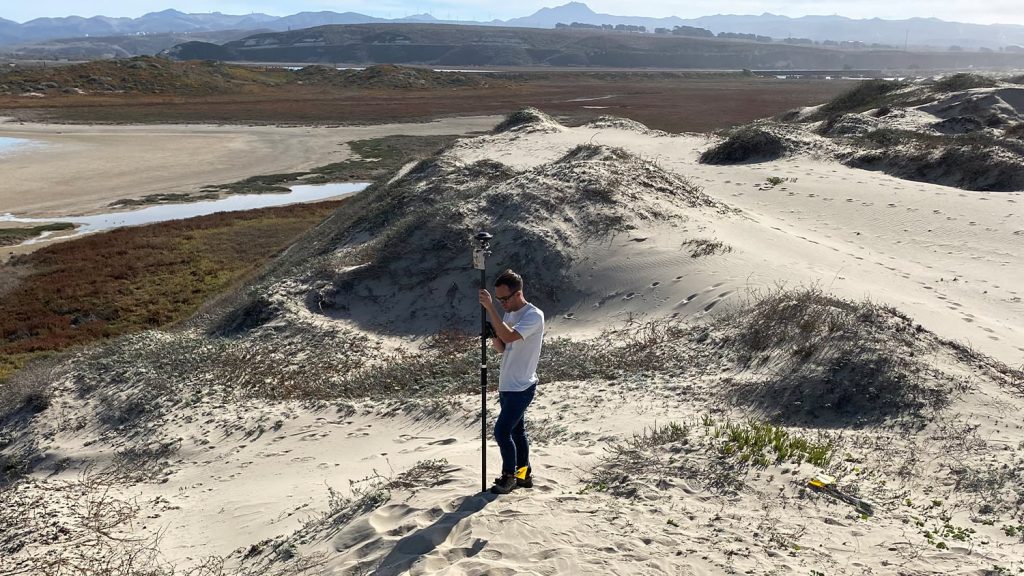
To enable more accurate predictions about sea level rise, Dr. Kyle Emery is piloting a drone, GNSS, GIS, and satellite imagery workflow.

Customer Spotlight: Ella Voorhees Brings Great Accuracy to the Great Smoky Mountains with GNSS
Ella Voorhees supports critical conservation efforts in Great Smoky Mountains National Park thanks in part to Eos GNSS receivers, Galileo HAS, and ArcGIS Field Maps.